

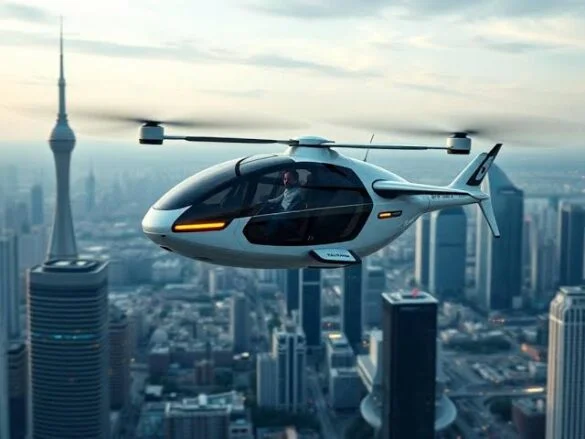
PARIS – At the 55th Paris Air Show 2025, China stunned the global aviation industry by unveiling an unmanned air taxi, signaling a revolutionary step forward in urban air mobility (UAM). This cutting-edge electric vertical takeoff and landing (eVTOL) aircraft captivated aviation experts, investors, and city planners with its futuristic design and smart capabilities.
The sleek, autonomous air taxi, which can carry two passengers for up to three hours, instantly became the highlight of the Chinese pavilion. Designed for use in densely populated cities, the aircraft doesn’t require a runway. Its VTOL technology allows it to take off and land vertically, making it highly adaptable to urban environments where space is limited.
Innovation and Sustainability in One Package
What sets this flying taxi apart is not just its autonomy, but also its commitment to sustainable aviation. The air taxi operates entirely on electric power, eliminating the need for fossil fuels. It offers a payload capacity of up to 600 kilograms, reflecting advanced Chinese engineering and robust performance standards.
The vehicle can operate in diverse weather conditions and is built with high-efficiency motors, advanced battery systems, and noise-reduction technology. Its eco-friendly design has attracted significant interest from global cities aiming to reduce carbon emissions and urban congestion.
Cutting-Edge Safety and Navigation
One of the key features of the unmanned air taxi is its state-of-the-art onboard navigation system. The aircraft is equipped with automatic routing, obstacle detection and avoidance, and precision landing technologies, all of which operate without human intervention.
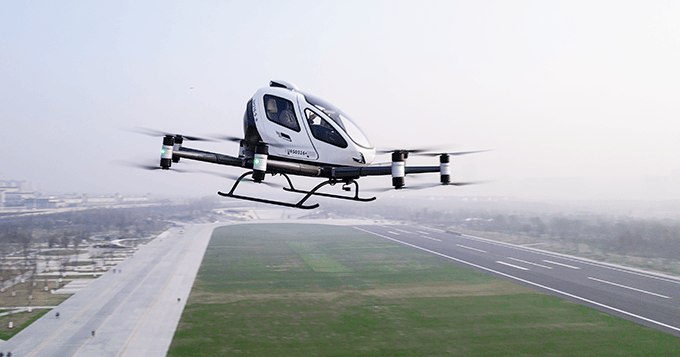
These advanced systems ensure a safe and smooth flying experience, making it a strong contender for future urban transport solutions. The aircraft prioritizes passenger safety, using multiple redundant systems and real-time data analysis to handle emergencies or route changes.
Global Implications and Future Potential
China’s debut of its high-tech air taxi at the Paris Air Show 2025 highlights its determination to lead the global aerospace sector. This strategic move reinforces China’s goal to drive the future of autonomous urban mobility.
Analysts see this development as a breakthrough toward commercializing air taxis in busy metropolitan areas. As demand for urban air mobility rises—especially in cities plagued by traffic and pollution—China’s innovation meets a critical global need. Furthermore, major cities across Europe, Asia, and the Middle East have already expressed interest in testing this aircraft.
Related: Pakistan’s Air Taxi Services Take Off
Pakistan has also entered the aerial transportation race. Recently, it launched air taxi services in Sindh and Balochistan, showing that the trend is catching on worldwide. These initiatives reflect a shared international vision: to modernize urban transit and reduce dependence on ground vehicles.
The Future Is Now
By combining sustainable design with cutting-edge automation, China has taken a bold step into unmanned aviation. It now stands at the forefront of the race for next-gen urban air travel.
This air taxi isn’t just a prototype—it’s a fully operational model. It signals a new era where people will travel faster, safer, and cleaner across cities using air-based solutions.
