

The Israel-Iran Ceasefire Agreement, proposed by former US President Donald Trump, signifies a pivotal step in resolving the conflict between the two nations. Prime Minister Benjamin Netanyahu’s government affirmed that the military campaign exceeded its goals, addressing nuclear and missile threats.
“Israel has dismantled existential nuclear and missile threats,” the government declared. The Israel Defense Forces (IDF) achieved air dominance over Tehran, incapacitated key Iranian military leaders, and destroyed strategic targets. Israel also expressed appreciation for US military support in countering Iran’s nuclear program.
The government warned of decisive responses to any ceasefire breaches, underscoring its firm stance.
Calls for Expanding the Ceasefire to Gaza
The Hostages and Missing Families Forum, an advocacy group, urged the Israeli government to extend the ceasefire to Gaza. They emphasized the need to secure the release of 50 hostages held by Hamas, 20 of whom are believed to be alive.
“Those who achieved a ceasefire with Iran can bring peace to Gaza,” the forum said. They called for urgent negotiations to bring home the hostages and end the conflict. Opposition leader Yair Lapid supported the call, highlighting the opportunity to close the Gaza front and rebuild Israel.
Humanitarian Impact of the Conflict in Iran
Israeli strikes on a residential building in northwest Iran killed at least nine people and injured 33 others, including women and children. The attack destroyed four residential units in Gilan province and caused significant damage to nearby properties. Footage from Astaneh-ye Ashrafiyeh showed large flames and crowds reacting to the devastation.
Residents of Tehran described the attacks as a nightmare, with evacuation warnings issued before Israeli strikes targeted various neighborhoods. Many reported sleepless nights and an urgent desire to leave the capital.
Ceasefire Implementation and Challenges
US President Donald Trump announced the ceasefire on Truth Social, urging all parties to honor the agreement. While Iranian and Israeli media reported the ceasefire had begun, precise details remained unclear. Reports indicated Iran launched multiple missile waves targeting Israel before the ceasefire took effect, causing casualties and extensive damage in cities like Beer Sheva.
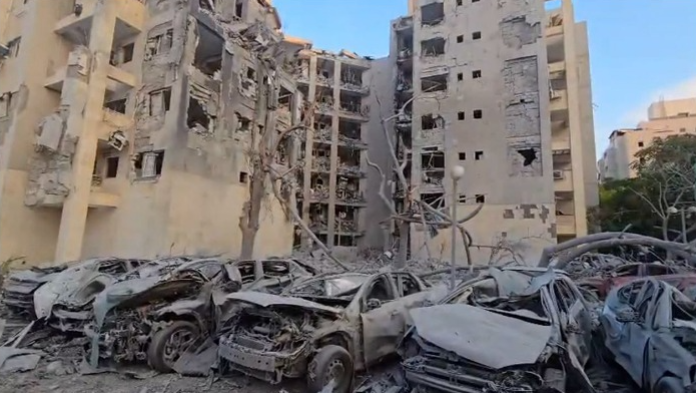
In Beer Sheva, Iranian missiles struck a residential building, killing five and wounding others. Emergency services rescued civilians from the rubble while ongoing efforts aimed to locate survivors. Images from the scene depicted extensive destruction, with concrete debris and damaged vehicles littering the streets.
Military Analysis: Prospects for Stability
According to military experts, the ceasefire could hold temporarily. Israel achieved significant objectives, including targeting Iranian nuclear facilities and crippling its air defense systems. Meanwhile, Iran may use the ceasefire to regroup and plan its next moves.
Retired Air Force Colonel Cedric Leighton noted, “Israel has achieved its goals, and Iran requires time to recover. This makes a temporary ceasefire feasible.”

Disruptions in the Middle East Airspace
Iran’s retaliatory strikes on a US air base in Qatar caused widespread disruptions in Middle Eastern airspace. Airlines temporarily rerouted or canceled flights, affecting travelers worldwide. Although Qatar and the UAE resumed operations, carriers like Air India suspended all flights to the region.
Aviation consultants highlighted that disruptions due to conflict are now a routine challenge for the industry, with airlines constantly monitoring airspace risks.
Broader Implications of the Israel-Iran Ceasefire
The ceasefire marks a pivotal moment in the region’s geopolitical dynamics. Israel’s decisive actions have demonstrated its military capabilities, while Iran faces the challenge of recovering from significant setbacks. Calls to expand the ceasefire to Gaza underscore the ongoing humanitarian and political complexities in the region.
This development highlights the need for sustained international engagement to address the root causes of conflict and promote long-term stability.
