

ISLAMABAD – Nepra Tariff Cut the National Electric Power Regulatory Authority (Nepra) has approved a Rs1.15 per unit reduction in electricity rates for all consumer categories, excluding lifeline users. This decision aligns with efforts to establish a uniform tariff structure across Pakistan, including for K-Electric consumers.
The move follows a recent hearing on the Power Division’s proposal to unify basic tariffs. Officials clarified that this rationalisation is not designed to boost federal revenue but to fulfill constitutional and policy requirements related to fair energy pricing.
Rates for Lifeline and Protected Users Remain Unchanged
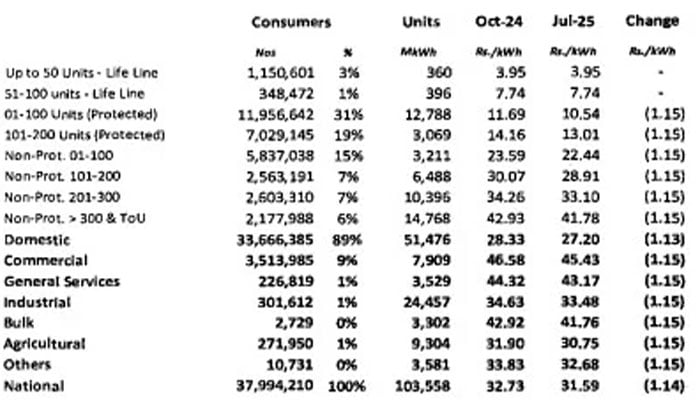
Lifeline customers will continue to pay Rs3.95 per unit for up to 50 units and Rs7.74 per unit for 100 units under the revised rate.
Low income households are guaranteed affordability with these unaltered rates.
In order to provide relief for vulnerable groups, protected users will now pay Rs10.54 per unit for 100 units and Rs13 per unit for 200 units.
Non-Protected, Commercial, and Service Consumers Get Relief
Tariff Relief for Non-Protected and Commercial Users
Non-protected domestic and commercial consumers will benefit from the Rs1.15 per unit reduction.
Commercial users will now pay a basic tariff of Rs45.43 per unit, while general service users will be charged Rs43.17 per unit.
Industrial users also gain relief. The new industrial tariff stands at Rs33.48 per unit.
Bulk consumers will now pay Rs41.76 per unit, and agriculture users get a lower rate of Rs30.75 per unit.
Government Attributes Cut to Economic Gains
At the Nepra hearing, government officials linked the tariff cut to multiple positive factors.
They cited rupee stability, lower global fuel prices, and a drop in capacity payments.
They also explained that renegotiated deals with Independent Power Producers (IPPs) will save Rs236 billion in FY2025–26.
Government Cites Currency and Fuel Stability
At the Nepra hearing, government officials linked the tariff cut to three main factors: rupee stability, falling global fuel prices, and lower capacity payments.
They also noted that renegotiated deals with Independent Power Producers (IPPs) would save Rs236 billion in FY2025–26 capacity charges.
Lower Revenue Targets and Consumption Forecast
The Power Division forecasts electricity consumption at 103 billion units for FY2025–26, slightly below last year’s 106 billion units.
Officials also revised the annual revenue target to Rs3.521 trillion, down from Rs3.768 trillion.
Despite lower tariffs, capacity charges remain high, totaling Rs1.766 trillion (or Rs17.06 per unit).
However, this reflects a Rs1.34 per unit drop from FY2024–25 levels.
Positive Impact on Inflation Control
Experts believe the tariff cut will ease inflation.
By lowering electricity and production costs, it could bring relief to both consumers and businesses.
Demand Further Reforms
The government is urged by stakeholders to build on this respite by increasing renewable energy sources, decreasing dependency on pricey imports, and making investments in energy efficiency.
Learn more about Finance News
