

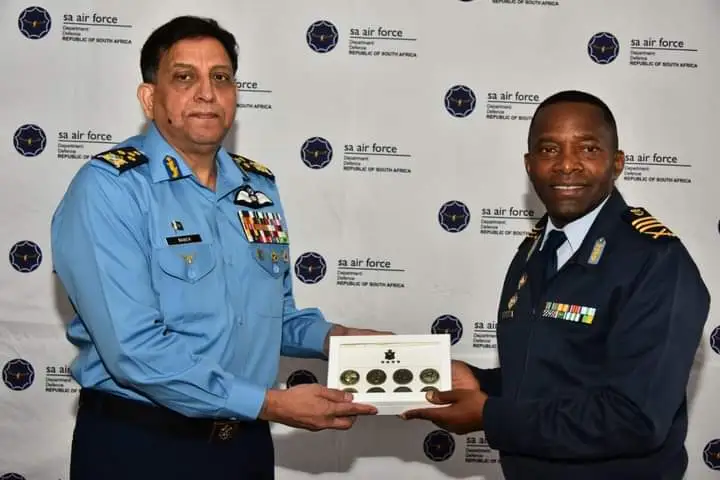
Military Leaders Meet in Islamabad to Strengthen Ties
ISLAMABAD – The South African Air Force (SAAF) has formally asked the Pakistan Air Force (PAF) to provide assistance in revamping its training programs and maintaining its C-130 Hercules transport aircraft. This request came during a high-level meeting in Islamabad between SAAF Chief Lieutenant General Wiseman Simo Mbambo and Pakistan’s Air Chief Marshal Zaheer Ahmed Baber Sidhu.
Both military leaders engaged in detailed discussions, focusing on training, technical collaboration, and long-term cooperation. The visit marks a pivotal moment in deepening SAAF and PAF defense cooperation.
Core Focus: Training and Technical Support
The meeting highlighted SAAF’s intention to enhance its air force training infrastructure. Lt Gen Mbambo expressed the need for a modern, structured training framework, beginning at the academy level. He emphasized that South Africa looks forward to learning from Pakistan’s successful training methodologies.
Air Chief Marshal Sidhu responded positively, reaffirming PAF’s commitment to helping friendly nations build their defense capacities. He emphasized that the Pakistan Air Force stands ready to offer customized training programs tailored to the specific requirements of the South African Air Force.
Recognizing PAF’s Operational and Training Excellence
During the discussion, Lt Gen Mbambo acknowledged PAF’s operational efficiency and professionalism. He praised the force’s capabilities in multi-domain warfare and noted its global recognition in military aviation.
He specifically mentioned Pakistan’s extensive experience in defense education and aviation engineering, stating that South Africa aims to adopt similar systems to improve its own air training programs.

PAF Commits to Tailored Training Programs
Air Chief Marshal Sidhu offered full support to design modern, need-based training courses for SAAF personnel. These programs would include both theoretical and practical components, ensuring a holistic approach to pilot and crew development.
The PAF Chief also proposed collaboration through knowledge sharing, capacity building, and direct mentorship. He suggested that Pakistani training institutions could provide advanced simulation exercises, air tactics modules, and classroom instruction to South African cadets.
Proposal to Observe PAF Operational Exercises
To deepen inter-air force understanding, Lt Gen Mbambo proposed the inclusion of South African officers as observers during major PAF exercises. He stated that such participation would offer SAAF personnel valuable insights into live operational scenarios and enable them to benefit from Pakistan’s real-time combat expertise.
The PAF Chief welcomed the idea, calling it a meaningful step toward building mutual confidence and fostering a spirit of cooperation. He noted that exposure to field-level training would help SAAF better understand the PAF’s command structures, technologies, and strategy execution.
Exploring Aircraft Maintenance Cooperation
Another key aspect of the meeting centered around technical collaboration on aircraft maintenance. The SAAF Chief expressed interest in Pakistan’s engineering capabilities, particularly regarding the upkeep of transport aircraft.
Lt Gen Mbambo showed a willingness to send SAAF’s C-130 Hercules aircraft to Pakistan for inspection and servicing. He recognized the cost-efficiency, high standards, and technical depth offered by the PAF’s maintenance infrastructure.
Pakistan’s aircraft overhaul facilities, especially those at Kamra, are known for maintaining international standards and successfully supporting both local and foreign air forces.

Building a Long-Term Strategic Framework
Both parties acknowledged the importance of formalizing their cooperation. They agreed that a planned, long-term defense partnership would provide direction and continuity. During the discussion, they proposed the creation of a joint working group. This team would manage training programs, oversee collaborative projects, and coordinate future efforts.
By establishing an institutional framework, the two air forces can align around shared goals. It will also allow them to monitor progress, adjust strategies, and respond swiftly to evolving defense needs.
Mutual Respect and Shared Strategic Vision
Throughout the meeting, both air chiefs emphasized mutual respect and a common vision for cooperation. Lt Gen Mbambo appreciated the professionalism and hospitality extended by the PAF. He noted that the visit laid the foundation for stronger air force-to-air force relations.
Air Chief Marshal Sidhu reiterated Pakistan’s principle of equal partnership. He stressed that the PAF welcomes knowledge sharing with nations that value excellence, innovation, and sovereignty in defense.
Implications for Regional and Global Cooperation
The expanding SAAF and PAF defense cooperation holds broader relevance. It demonstrates how developing nations can support each other through cost-effective and impactful collaboration. As many countries aim to improve their defense systems, such partnerships offer practical alternatives to traditional alliances.
Pakistan’s outreach in training, logistics, and aviation services shows its growing regional role. Likewise, South Africa’s interest in diversifying its military ties highlights its commitment to improving operational readiness and strategic depth.
Conclusion: Strengthening Bonds for a Secure Future
Lt Gen Wiseman Simo Mbambo’s visit to Pakistan and his meeting with Air Chief Marshal Zaheer Ahmed Baber Sidhu marked a key step forward in bilateral defense relations. Their dialogue covered every major area—training, operations, and aircraft maintenance.
With clear plans for training support, joint exercises, and technical collaboration, both nations have signaled their intent to move forward. The foundation is now set for a defense partnership built on trust, strategy, and shared goals.
As Pakistan and South Africa continue their engagement, the deepening of SAAF and PAF defense cooperation stands as a model. It shows how nations can work together to enhance security and build resilient, modern air forces through mutual respect and aligned priorities.
