

Imagine downloading the entire Netflix library or the entire contents of YouTube in less time than it takes to open the app on your phone. This futuristic scenario isn’t science fiction anymore. Thanks to researchers in Japan, the world has taken a giant leap forward in internet speed, potentially redefining how we think about connectivity, communication, and even reality itself.
In June 2025, a team of scientists from Japan’s National Institute of Information and Communications Technology (NICT) achieved a stunning breakthrough. They transmitted data at an unprecedented 1.02 petabits per second that’s 1,020,000 gigabits per second, or over a million times faster than most average home internet speeds around the world.
What Is a Petabit Per Second, and Why Does It Matter?
To grasp the significance of this milestone, let’s put that number into perspective. One petabit per second (Pbps) is equivalent to 125,000 gigabytes per second. That means in theory, you could:
- Download 12,500 full-length HD movies in a single second.
- Transfer the entire contents of Wikipedia dozens of times over instantly.
- Stream hundreds of thousands of 8K ultra-HD videos at the same time without buffering.
This isn’t just about speed for speed’s sake. Achieving 1.02 petabits per second paves the way for a new era of data-driven innovation including AI, cloud computing, VR/AR, quantum research, and futuristic smart cities all powered by ultra-fast, reliable internet.
How Did Japan Achieve This Internet Milestone?
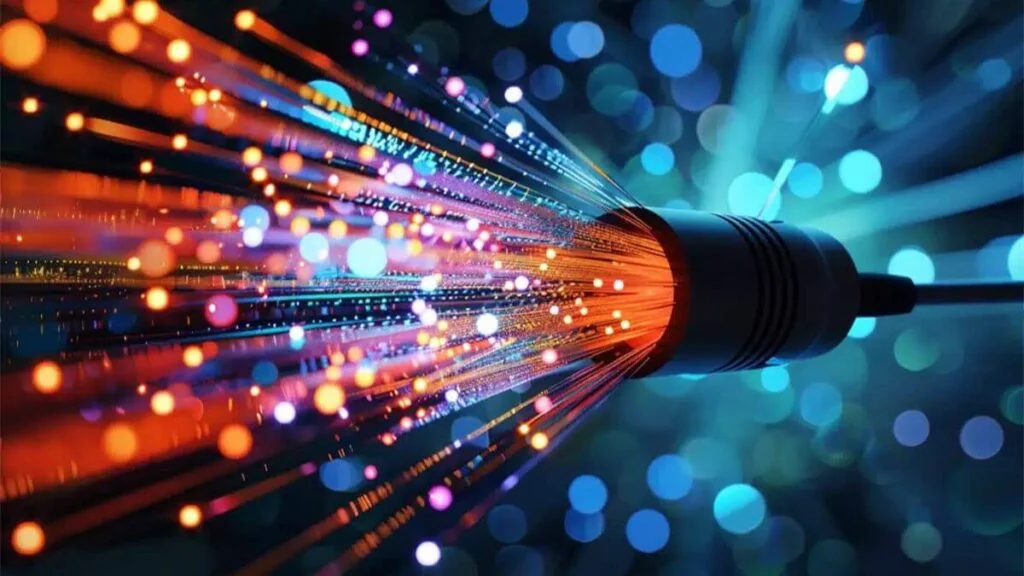
The researchers at NICT used a specialized optical fiber that goes far beyond the standard ones used today. Their system incorporated:
- Four-core fiber optics, capable of carrying multiple streams of data simultaneously.
- Advanced wavelength division multiplexing (WDM), which allows dozens of wavelengths (or colors of light) to transmit separate data channels down the same fiber.
- A transmission distance of 51.7 kilometers, showcasing real-world potential rather than lab-only success.
Unlike past record-breaking attempts limited to short-distance or niche applications, this experiment demonstrated both incredible speed and practical scalability. According to the NICT team, this system could be integrated into existing infrastructure with minimal adjustments a huge advantage over less compatible high-speed tech.

How Fast Is This Compared to Today’s Internet?
Let’s compare Japan’s new record with real-world internet speeds as of 2025:
| Type of Connection | Average Speed |
|---|---|
| Global Average Broadband | ~100 Mbps |
| 5G Mobile Networks (Peak) | ~10 Gbps |
| Google Fiber (US) | 2–5 Gbps |
| NASA’s Research Network | ~91 Gbps |
| Japan’s Record (NICT) | 1,020,000 Gbps |
This means Japan’s test internet speed is over 10,000 times faster than NASA’s fastest current internet. It completely dwarfs even the most high-end commercial networks used by cloud giants like Amazon, Google, or Microsoft.
What Could This Mean for the Future?
The implications of 1.02 Pbps internet speed go far beyond entertainment. This breakthrough could revolutionize:
1. Healthcare and Remote Surgery
Doctors could perform real-time robotic surgeries across continents with zero latency, saving lives in remote areas with advanced remote care capabilities.
2. Artificial Intelligence
AI systems, particularly large-scale models like those used in autonomous vehicles or natural language processing, rely on immense data transfer. Ultra-fast internet would allow real-time AI decision-making across networks, enhancing safety and accuracy.
3. Education and Global Classrooms
Classrooms of the future could include full VR/AR learning experiences without lag, allowing global collaboration and virtual field trips to space, museums, or inside the human body.
4. Disaster Management
Emergency response teams could receive real-time high-resolution satellite feeds, drone footage, and predictive models during natural disasters improving speed and precision in life-saving operations.
5. Entertainment and Immersive Tech
From instant gaming downloads to seamless 8K+ streaming, cloud-based gaming platforms like Xbox Cloud, GeForce Now, or PlayStation Now would feel truly “local.” The metaverse, previously a laggy dream, would become a fully immersive, lag-free experience.

Is It Available Yet?
Not quite. While this technology is not commercially available right now, the experiment’s compatibility with existing systems means deployment could happen sooner than expected. The NICT team noted that with industry investment and regulatory approval, real-world rollouts might start within the next 5–10 years especially in tech-forward countries like Japan, South Korea, or Singapore.
However, rolling out this kind of speed to homes or businesses will still require significant investment in infrastructure, including updated fiber networks and routers capable of handling such high throughput.
What Are the Challenges?
With any breakthrough comes hurdles. These include:
- High cost of deployment
- Energy consumption of ultra-speed systems
- Signal stability over long distances and environments
- Security concerns due to massive data movement
Nevertheless, experts believe these challenges are solvable with further research, international collaboration, and smart policymaking.
The Bigger Picture: Competing for Speed
Japan’s achievement comes amid a global race for faster internet. Countries like the United States, China, and the European Union have already invested billions into 6G research, quantum networks, and ultra-broadband technologies.
This breakthrough puts Japan ahead in the race not just as a developer of fast internet but as a leader in next-gen digital infrastructure that will drive innovation across every sector of society.
Conclusion: A Future Reimagined
The record-breaking 1.02 petabits per second speed achieved by Japan’s NICT may not affect your home Wi-Fi just yet. But it gives us a powerful vision of what’s coming. In this future, distance disappears, lag vanishes, and information moves at the speed of thought.
From remote surgery to VR education and global AI systems, ultra-fast internet won’t just be a luxury it will be a foundation for the future. And with this milestone, Japan has shown the world what’s possible when cutting-edge science meets long-term vision.
Read more Latest News
