


New York’s Central Park reached a scorching 96 degrees on Monday, a record high last seen in 1888. This extreme heat wave poses a significant threat, affecting millions across the region. In New Jersey, 16 individuals were sent to the emergency room following heat-related illnesses during outdoor graduations. Baltimore faced challenges when a malfunctioning Amtrak train left passengers stranded without air conditioning in tunnels.
Extreme Heat Wave Peaks Across the Eastern US
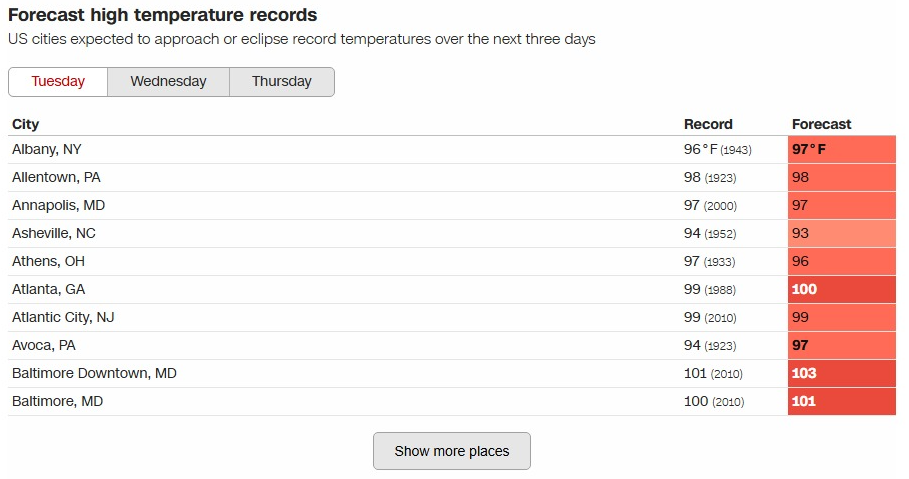
A dangerous heat wave is sweeping across the eastern United States, with temperatures peaking on Tuesday. The heat dome behind these extreme conditions has brought the hottest temperatures seen in years for many cities. Over 250 daily temperature records are at risk of being broken. Cities from Philadelphia to Boston could experience their hottest days in over a decade, with more records possibly falling on Wednesday and Thursday.
The National Weather Service (NWS) issued heat alerts for 150 million people on Monday. Temperatures soaring 15 to 20 degrees above normal make it feel more like mid-summer than late June. A level 4-of-4 extreme heat risk warning is in place through Thursday, spanning the Midwest, Mid-Atlantic, and parts of the Northeast. The relentless heat offers little overnight relief, increasing risks of heat-related illnesses, especially for children, the elderly, and those with pre-existing health conditions.
Immediate Impacts of Sweltering Conditions
The intense heat led to several incidents on Monday. In Paterson, New Jersey, two graduations resulted in over 150 attendees evaluated for heat-related illnesses, with 16 hospitalized. Paterson Fire Chief Alejandro Alicea confirmed those hospitalized were in stable condition.
In Baltimore, an Amtrak train malfunctioned, leaving passengers in uncooled cars for over an hour. Passenger Laura Evans described the ordeal, noting the unbearable conditions even before the train stalled. Amtrak spokesperson Olivia Irvin said passengers were transferred to Baltimore Station and provided onward transportation, along with bottled water and snack packs.
Washington, DC, closed the Washington Monument on Monday and Tuesday due to an Extreme Heat Warning issued by the National Park Service. Power outages also plagued the region, with over 100,000 homes and businesses losing electricity in Ohio, Pennsylvania, New York, and New Jersey, according to PowerOutage.us.
Infrastructure and Travel Challenges Under Extreme Heat
The sweltering temperatures are taking a toll on infrastructure. Concrete and asphalt are expanding and warping under the heat. Over the weekend, roads in Milwaukee and Green Bay, Wisconsin, buckled, forcing closures. Similar issues were reported in Cape Girardeau, Missouri, where city officials warned of potential road damage as the heat continues.
Rail and air travel are also affected. Electrified train wires are sagging due to the heat, leading to slower train speeds and potential delays. Amtrak confirmed temperature-related speed restrictions for some services in the Mid-Atlantic and Northeast. For air travel, the reduced density of hot air makes takeoffs more challenging, adding another layer of disruption.
Record-Breaking Temperatures Across Major Cities
New York City tied its daily high of 96 degrees on Monday, marking the hottest day since August 2022. The city could hit 100 degrees on Tuesday, a rare event in June. Philadelphia is also experiencing near-record heat, with Tuesday’s forecasted 101 degrees coming close to the city’s hottest June day on record.
Boston is bracing for potentially record-breaking temperatures, with forecasts predicting 102 degrees on Tuesday. Washington, DC, faces three consecutive days of triple-digit heat, breaking multiple daily records. Even northern New England is not spared; Burlington, Vermont, recorded one of its three hottest June days ever on Monday, reaching 97 degrees.

Gradual Cooling Expected
Temperatures are expected to ease gradually starting Wednesday, particularly in the Midwest and New England. Thursday will bring the most significant shift toward normal June temperatures for much of the eastern United States. Despite this reprieve, the early-season heat wave offers a stark preview of the hotter-than-normal summer forecasted for the entire Lower 48 states by the Climate Prediction Center.
Heat Waves: A Growing Threat
Heat waves remain the deadliest form of extreme weather in the United States. The frequency and duration of such events have increased significantly in recent years due to climate change. Nighttime temperatures, in particular, are warming faster than daytime highs, exacerbating the risks associated with extreme heat.
The current heat wave highlights the critical need for preparedness as climate change drives more frequent and intense heat events. Communities must prioritize infrastructure resilience and public health measures to mitigate the dangers of extreme heat.
