


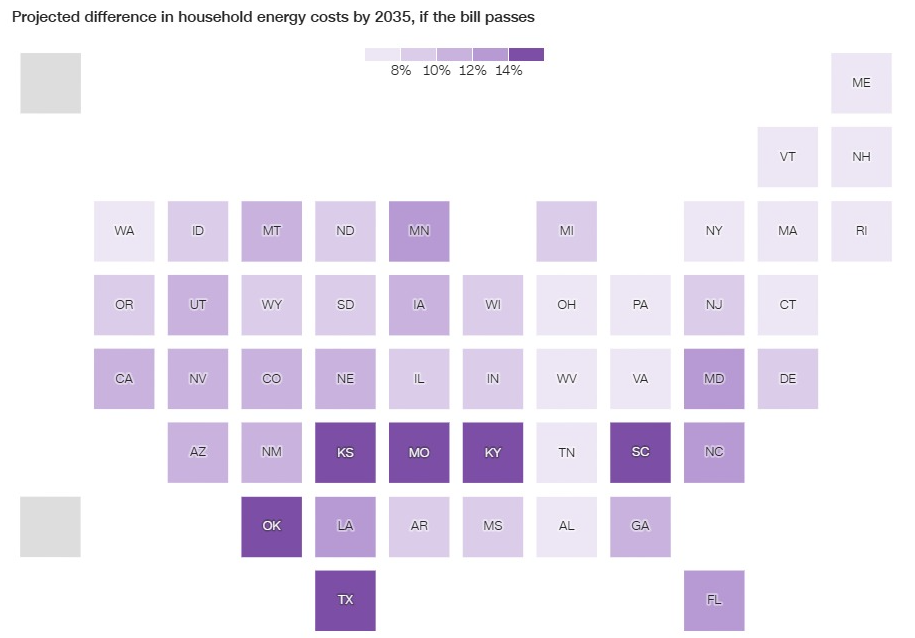
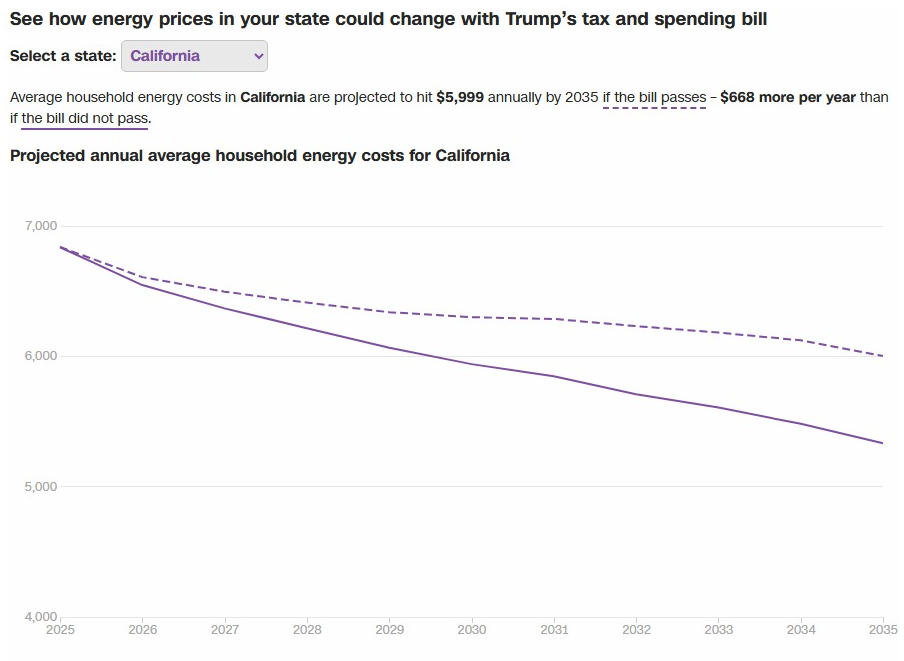
Higher household energy bills are expected across the United States if Republicans pass their proposed tax and spending bill, according to a recent analysis. This prediction comes from a recent analysis by Energy Innovation, a prominent think tank.
Impact on Renewable Energy Projects
President Donald Trump and Republican lawmakers aim to eliminate key tax credits designed to lower the cost of building wind and solar projects. These renewable energy sources are now often more cost-effective than fossil fuels like coal and natural gas. The Biden administration’s tax incentives were set to accelerate the deployment of cheaper, renewable energy projects, helping to stabilize utility bills. Removing these incentives could drive up electricity costs nationwide.
Broader Implications for Energy and Transportation Costs
The analysis also highlights that repealing the electric vehicle (EV) consumer tax credit will lead to higher transportation costs. Without the $7,500 credit, more people are expected to continue using gas-powered vehicles, further increasing gasoline demand and prices. Energy Innovation’s model, which excluded Hawaii and Alaska, estimated rising costs for household electricity, heating, and transportation across the continental United States.
Red States Face Steep Cost Increases
Red states like Oklahoma, South Carolina, and Texas are projected to experience the largest spikes in energy costs. By 2035, household energy expenses in Oklahoma could rise by as much as $845 annually, with Texas households seeing increases of $777 per year. These states, rich in wind and solar resources, were poised to deploy significant renewable energy projects under the Biden-era tax credits. The elimination of these credits would force a reliance on more expensive natural gas, driving up costs.
Oklahoma, for instance, generates 44% of its electricity from wind. Energy Innovation’s modeling indicated that with tax credits intact, Oklahoma could transition to a carbon-free electricity grid and become a major electricity exporter. Without these credits, renewable deployment will stagnate, and fossil fuels will fill the gap.
Blue States Less Impacted
Blue states that have already prioritized clean energy initiatives are expected to see smaller increases in energy costs. These states are less reliant on gas and coal, making them more resilient to price shocks. Robbie Orvis, Energy Innovation’s senior director of modeling and analysis, explained that shifting from renewable energy back to fossil fuels would significantly raise costs.
Rising Costs of Fossil Fuels
Energy analysts predict that natural gas prices and the cost of building new gas-powered plants will continue to rise. This increase, coupled with growing electricity demand, will lead to higher utility bills. Rich Powell, CEO of the Clean Energy Buyers Association, noted that many people mistakenly view gas as a cheap power source. “New-build natural gas is not a cost-effective way to generate electricity,” he said.
Powell’s organization, along with NERA Economic Consulting, conducted independent analyses that support Energy Innovation’s findings. They emphasize that the removal of renewable energy tax credits will burden consumers with higher energy expenses.
Increasing Demand for Electricity
Demand for electricity is rising due to the growth of data centers and the electrification of homes and vehicles. Since 2022, retail electricity prices have increased faster than inflation, according to the U.S. Energy Information Administration (EIA). This trend is expected to continue, with both electricity and natural gas prices projected to climb in the coming years.
Transportation Costs on the Rise
Without the EV tax credit, more consumers will stick with gas-powered cars, further driving up gasoline prices due to increased demand. Orvis noted that this would significantly raise household transportation costs, compounding the financial burden on families.
State-Specific Impacts
Oklahoma
Oklahoma’s wind energy sector, which currently generates nearly half of the state’s electricity, stood to expand dramatically under the Biden-era tax credits. The loss of these incentives means the state will have to rely more on in-state fossil fuels, curbing renewable growth and increasing costs.
South Carolina
South Carolina, another state facing steep cost hikes, generates much of its electricity from nuclear and natural gas. The state was poised to add significant solar capacity under tax incentives. However, the proposed tax plan would force a shift back to gas, making energy more expensive.
Timing and Broader Economic Implications
The potential repeal of solar and wind tax credits comes at a challenging time. With increasing electricity demand and a transition to more electrified infrastructure, renewable energy offers a cost-effective solution. Eliminating these incentives would hinder progress and exacerbate financial pressures on households.
“Everybody’s electricity prices are going to go up,” Powell warned, stressing the urgency of maintaining renewable energy incentives.
Conclusion
Energy Innovation’s analysis paints a clear picture: repealing tax credits for renewable energy and EVs will result in higher energy and transportation costs for American households. Red states stand to lose the most, with substantial increases in utility bills and missed opportunities for renewable energy expansion. As debates over the tax and spending bill continue, the economic and environmental stakes remain high.
